01
The Star Average Barely Moves Between Sets
Compare the 65-review R-King Motorcycle against the 1,292-review Big Boy Locomotive and both land within a tenth of the same average after months on buyers' shelves.
Technic-style building sets
Bricks that aren't LEGO earn skepticism, so start with the numbers: these Technic-style sets span 572 to 4,099 pieces at a 4.4-star average across 3,612 verified buyer reviews.
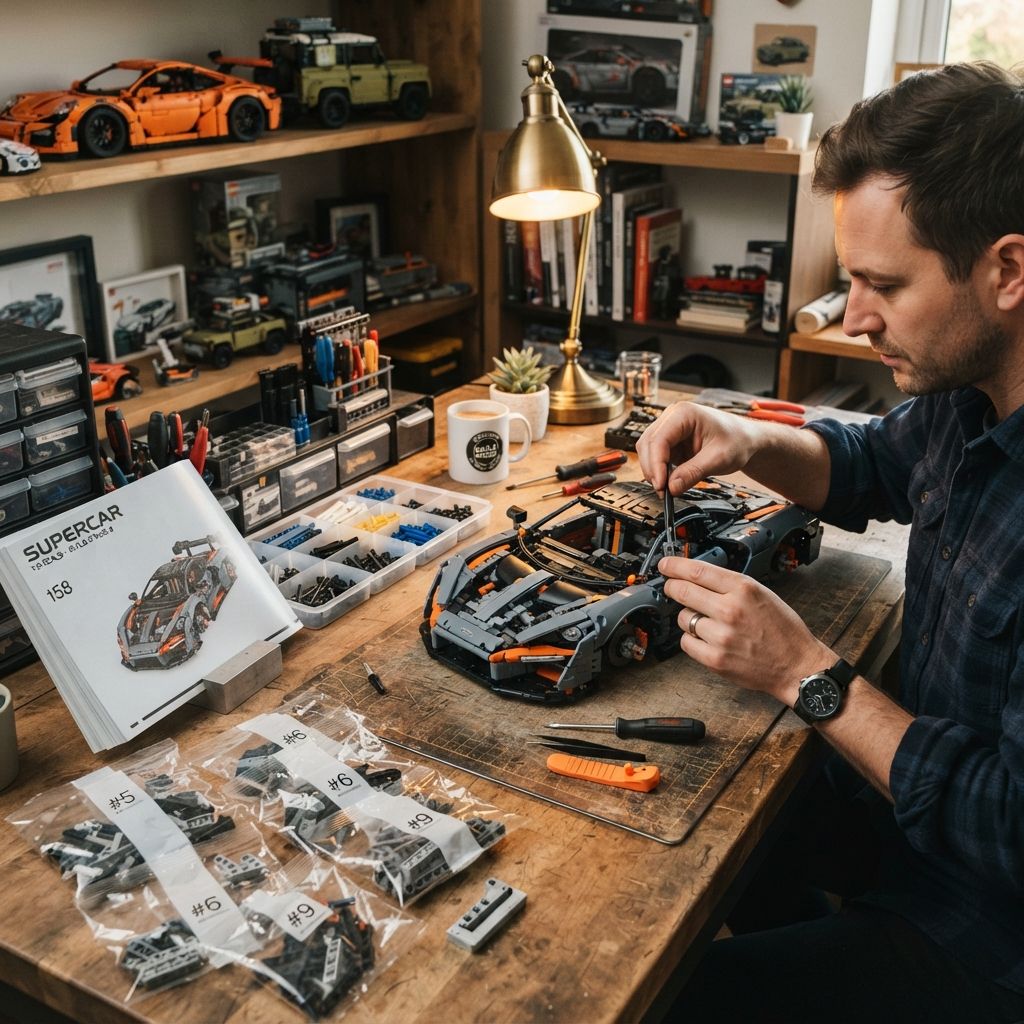
Build hours run 4 to 20 by set, and part finish, sorting, and moving mechanics decide which one earns the desk.
Compare the 65-review R-King Motorcycle against the 1,292-review Big Boy Locomotive and both land within a tenth of the same average after months on buyers' shelves.
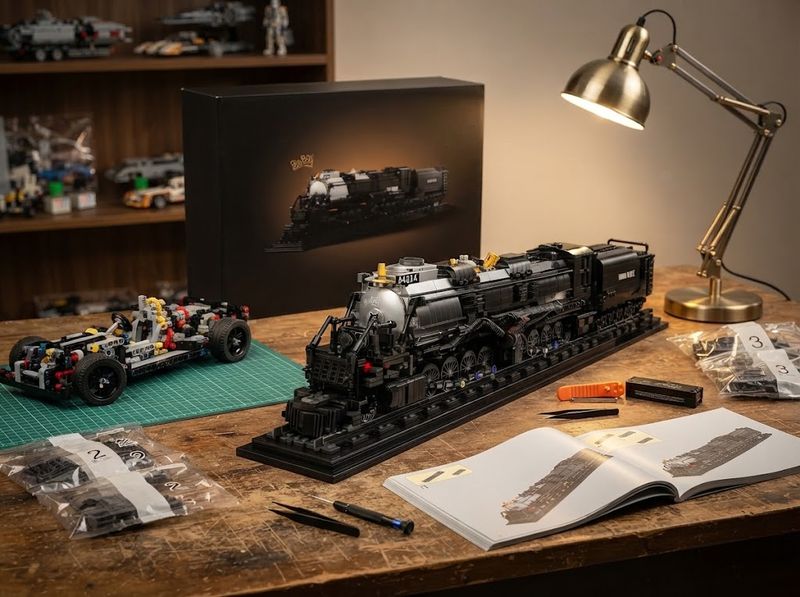
Four storage boxes ship with the Big Boy Locomotive, so an 1,818-piece build sorts onto a coffee table instead of spilling across a floor for a week.
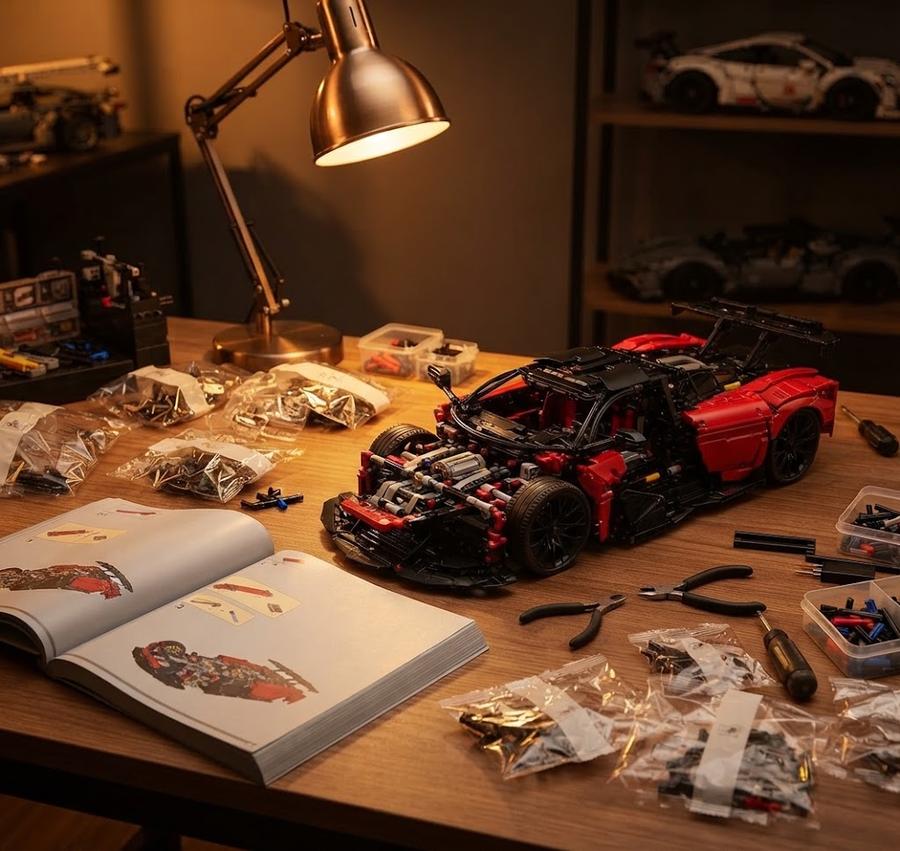
Flip the paddle behind the ASIL Sports Car's wheel and the gearbox steps through 7 positions; the wiper key drops the split suspension from track-stiff to soft in one turn.
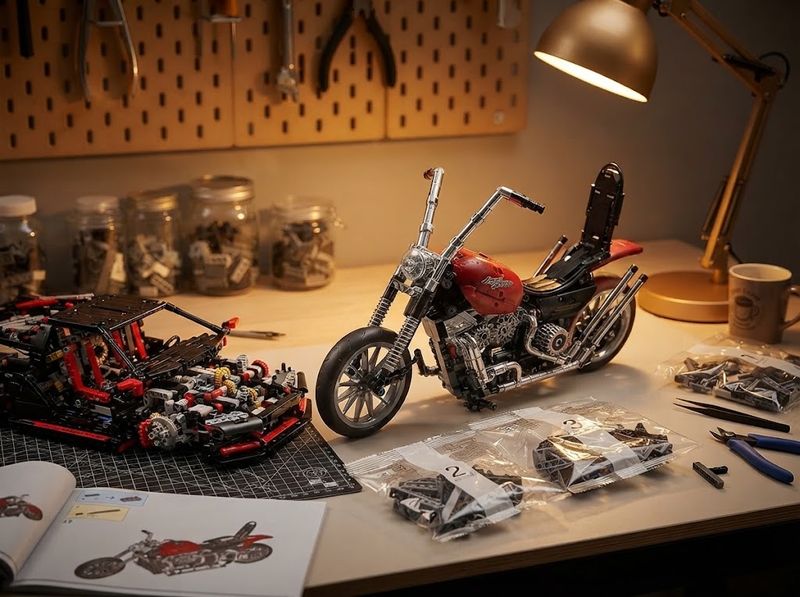
Four hours on a Saturday finish the 572-piece Chopper Motorcycle in one sitting, its electroplated engine parts catching light on a shelf by midnight.
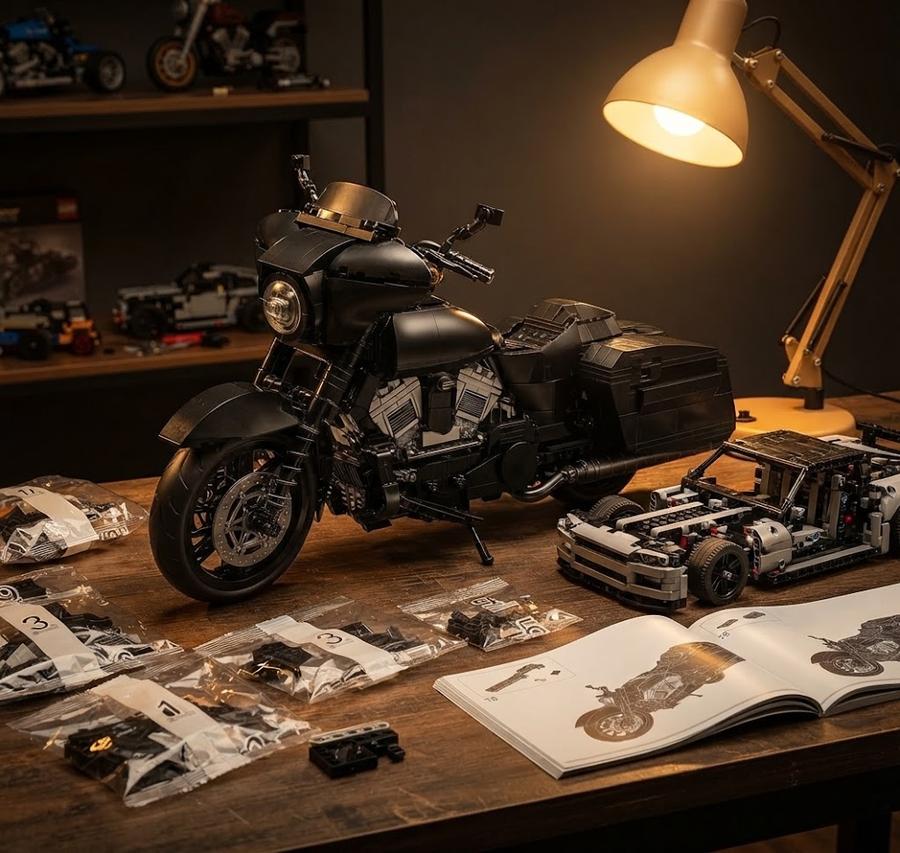
Lift the R-King Motorcycle's instrument cluster out of its bag and the gauges are printed onto the part, not applied as a decal at the last step.
No brand warranty period appears on the listings, so a torn bag or a short count goes back through the retailer's standard 30-day return window instead.
Nifeliz splits its Technic-style builds across trains, supercars, off-road trucks, motorcycles, and bare display engines, with model years dated 2023 through 2026.
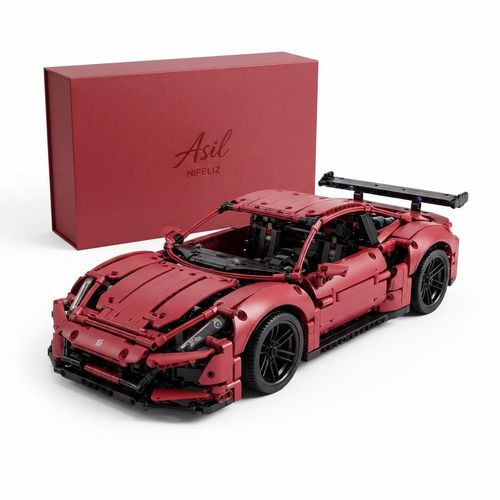
Book twenty hours across three weekends and 4,099 parts stack into a crimson supercar that settles at 6.49 kg on the shelf. Flip the paddles behind the wheel and the gearbox steps through 7 positions; the wiper key raises and lowers the split suspension between track-stiff and cruise-soft. Pull the rear cover off a year after assembly and the V12 bay is still reachable, where most large display kits stop at butterfly doors. Stop after box three on a Tuesday night and the two instruction books mark exactly where the next session picks up. The heaviest and largest set here, so measure the shelf before the carton lands; the retailer's return window still applies.
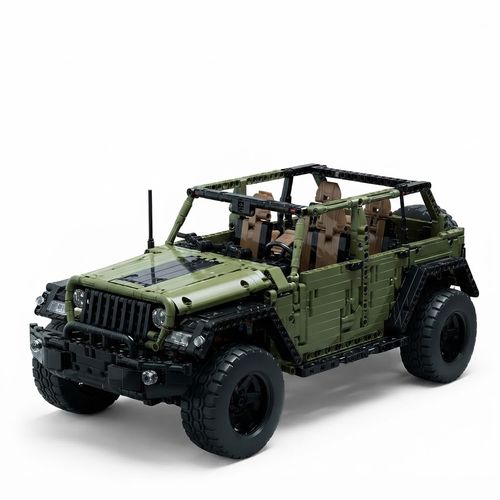
Shift the cabin lever from high to low range, then from two-wheel to four-wheel drive, and the transfer case moves under the floor of the finished truck. Take on 2,899 parts over about 14 hours and you finish the only Advanced-rated kit here, 4.63 kg on the shelf. Try to lift the roof off a trail-styled display model and it is glued down for good. Lift the roof and doors off this one and an open trail form is ready in under a minute. Hood, doors, and tailgate open and lock, and the inline-four pistons run off the wheels. Stop on a Wednesday night mid-axle, close the five storage boxes, and Saturday picks up exactly where you left it.
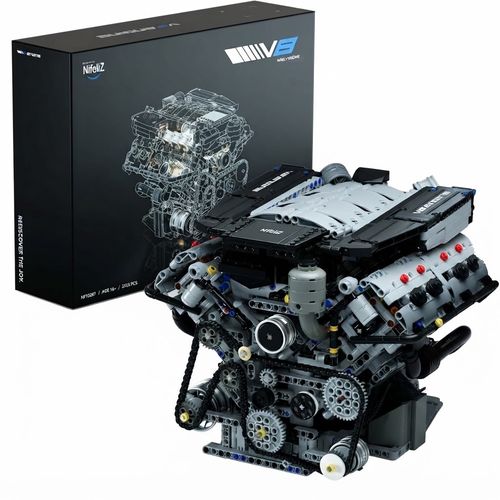
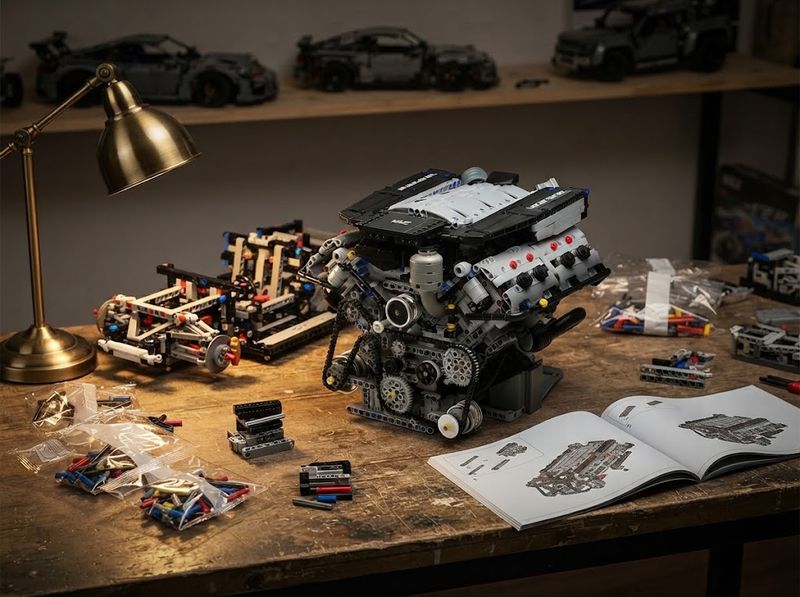
Turn the manual lever on the finished block and pistons and valves cycle in sync while the central fan spins for the turbocharged effect. Clear a desk corner roughly 11 inches wide, then work 2,725 parts into a V8 across about 8 hours. Lift a static engine model in both hands and every part stays bolted into one fixed pose. Drop a hand onto this lever and the whole valvetrain cycles. Owners report the occasional missing small part such as an elastic band, so count the bags before assembly starts and use the retailer's return window if the count comes up short.
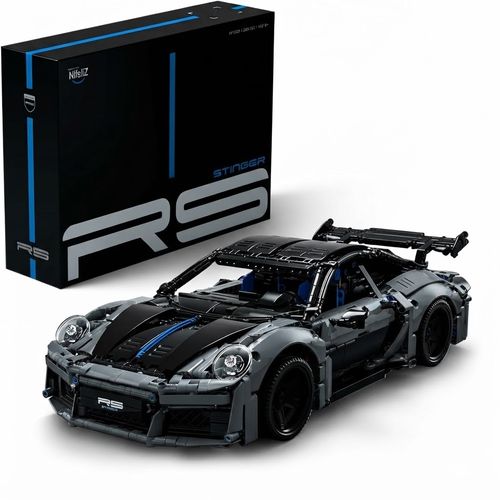
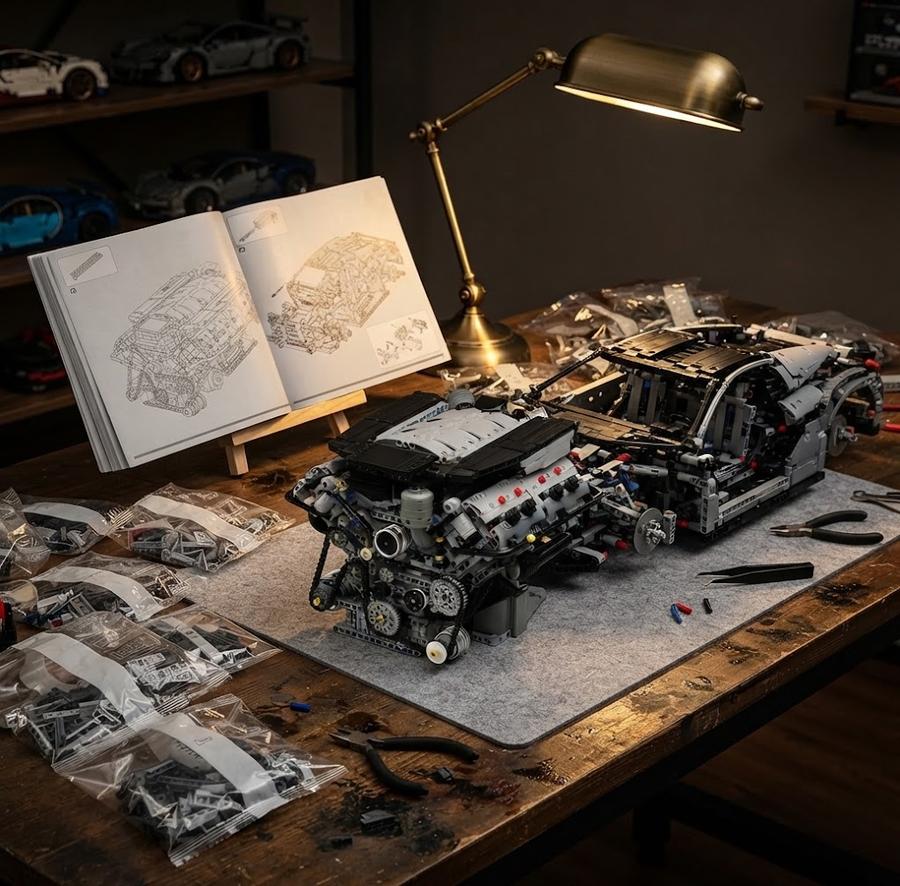
Push the finished car forward on a desk and the linked V6 strokes behind a rear cover that lifts away in one motion. Turn the wheel and the front wheels follow through a real steering linkage; flip the shifter between high and low, then press the body to feel the suspension load. Lift the rear cover on a flat-molded alternative kit and a moulded block sits under it; lift this one and the crank runs geared straight to the axle. Close the last panel at the eleven-and-a-half-hour mark and you are holding the highest-rated build on this page. Open all four boxes the night the carton lands and check the bag numbers against the manual; the retailer's return window covers a short count.
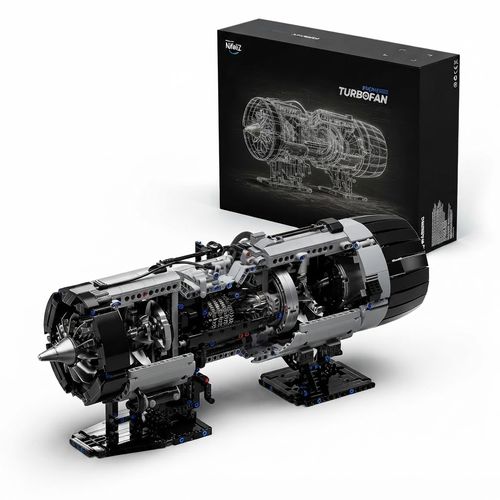
Crank the handle after 7.5 hours of assembly and linked shafts spin in opposite directions on a single axis. Sort 2,216 parts across four storage boxes and the semi-exposed frame skips the cowling that would hide a gear train. Close the last panel on a sealed engine replica and the inside is gone for good. Hand this one across a desk two months later and every shaft and joint is still there to trace. Run a thumb along the housing after the paint cures and the metallic finish holds the machined look, seam to seam. Weigh the finished frame at 3.53 kg, then read the 212 verified buyer reviews behind its 4.5-star record.
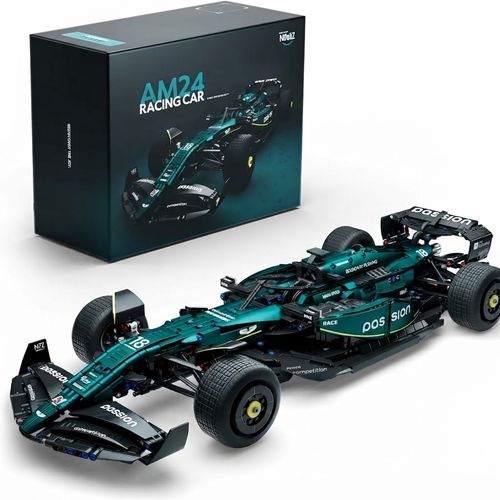
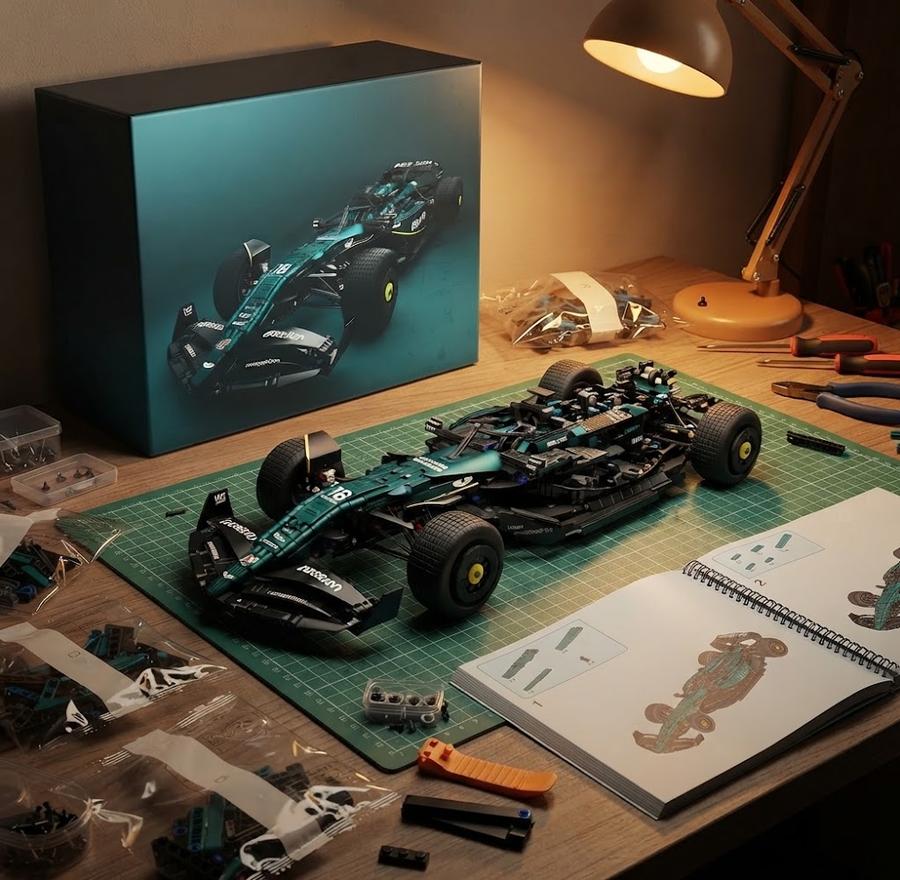
Steer the finished F1 car by its interactive linkage and the front wheels answer while the suspension loads through the chassis. Work 2,351 parts across roughly 8.5 hours and a 26-inch racer takes shape with a differential under the rear axle. Turn the wheel on a display-only F1 shell and nothing answers; turn this one and the linkage through the nose pulls the front wheels with it. Authentic stickers finish the livery, so budget a slow final hour for decal placement rather than rushing it. Open four storage boxes in the carton the day it lands, and 310 verified buyer reviews back the 4.5-star record.
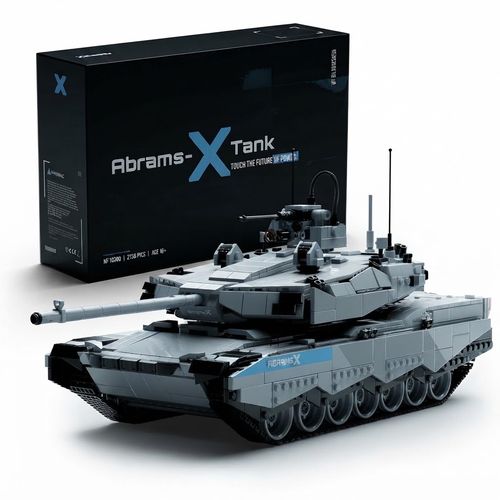
Lift the upper hull off two winters after assembly and the driver's seat, loader area, and engine bay are still there to inspect. Hand 2,136 parts to a builder aged 16 or up and about 8.2 hours later a 17-inch hull stands at 3.02 kg. Seat the last plate on a sealed military display model and the interior closes for good; this hull comes apart again instead. Set the open hull on a desk after a year and the printed cockpit dials and metallic engine parts still read clean. The lowest rating on this page at 4.3 stars across 114 verified buyer reviews, so read the recent ones first.
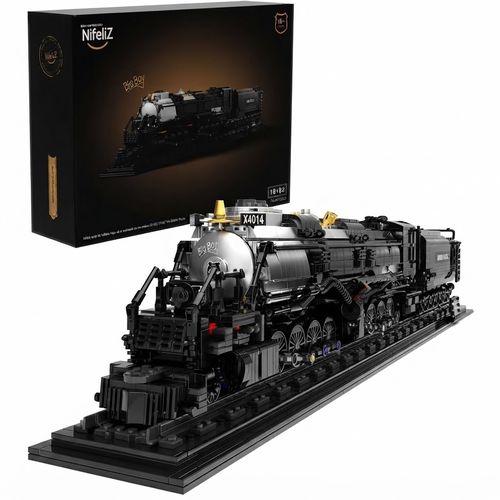
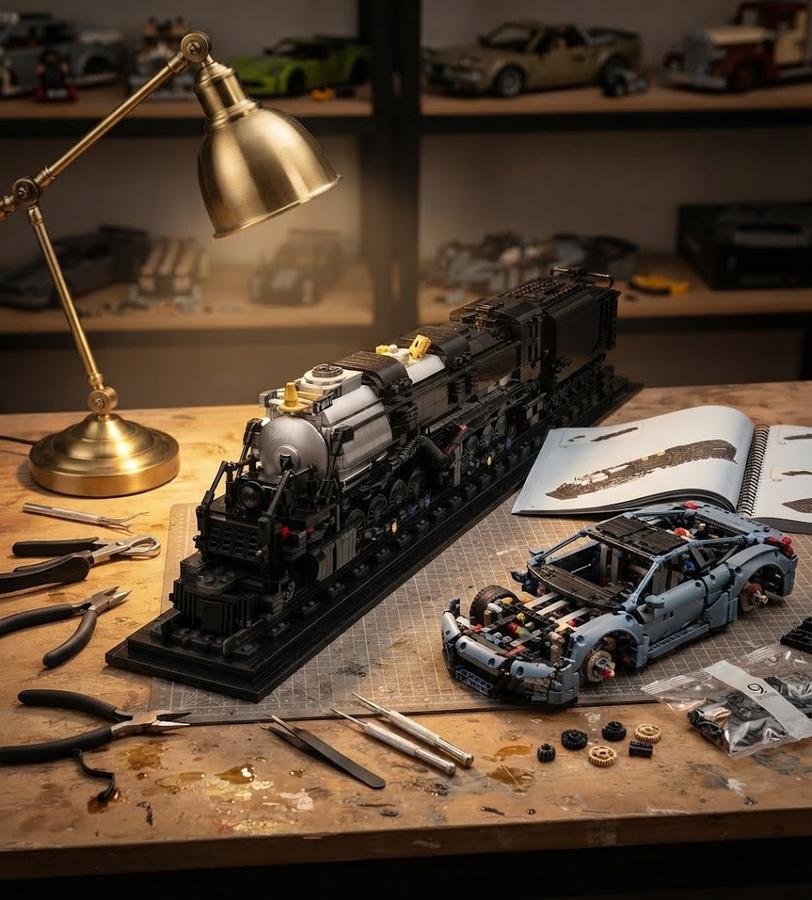
Clear 4 hours on a rainy Saturday and 1,818 parts become a 31-inch articulated Big Boy locomotive with silver electroplated trim along the boiler. Stop mid-build on a Sunday night, drop the loose parts back into their numbered bag, and four storage boxes hold the sort until next weekend. Set the finished locomotive on its included track base, then crouch to eye level: every connecting rod and linkage stays in view, nameplate and all. Wheel friction runs high enough that owners report it dragging rather than coasting on track, so check the axle seating during the retailer's return window. Scroll the buyer reviews before you commit those four hours; no other build on this page carries a record that deep.
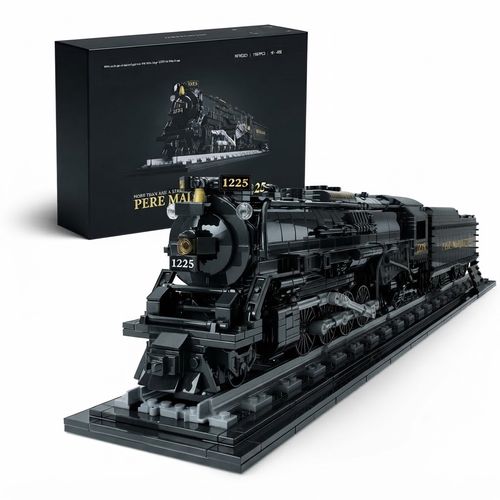
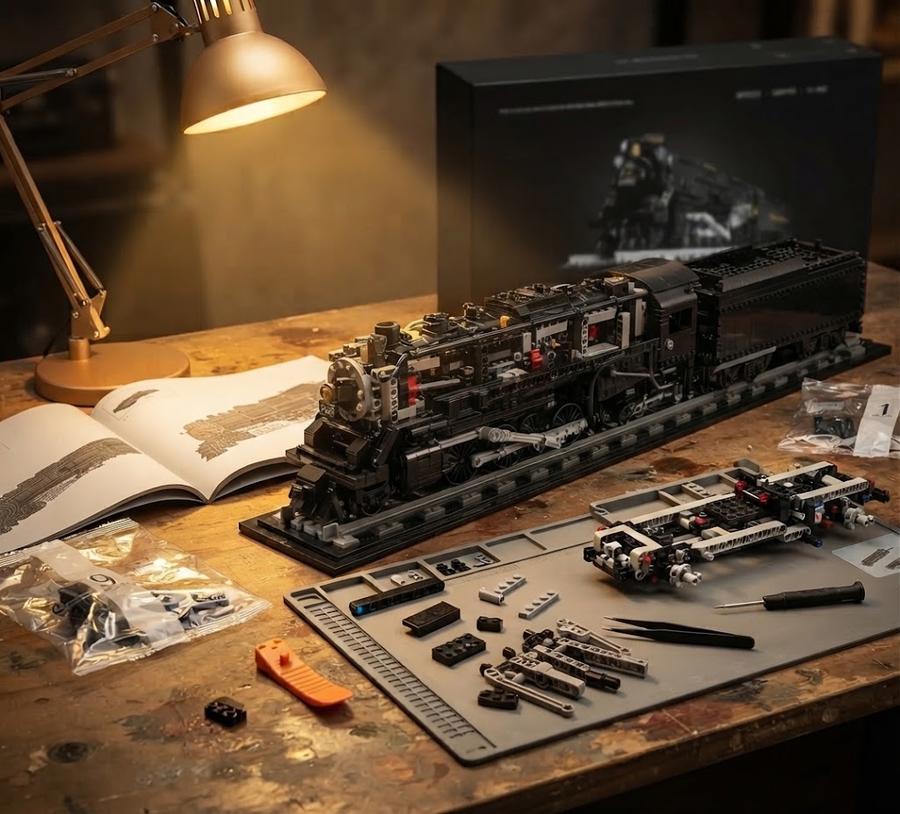
Turn the small roof part after six hours of building and the driving wheels move together along the rods. Open four storage boxes of numbered bags, work through 1,593 parts, and settle the finished locomotive onto its nameplate track base. Lean into the cab and printed gauges and controls wait inside, moulded into the parts rather than stuck to the shell. Lift this 2.85 kg locomotive with one hand; the 31-inch Big Boy needs two and a clear span of shelf. Compare the 4.5-star record across 258 verified buyer reviews against the bigger train before you clear six hours for either.
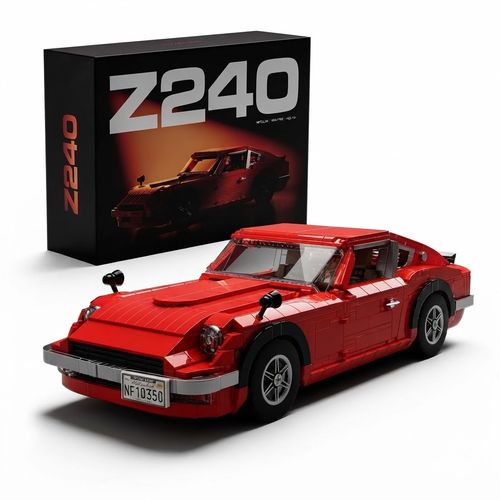
Lift the long hood after about 6.8 hours of building and the metallic-painted engine sits under it, laid out the way the bodywork wraps around it. Swing the doors open on the finished 14-inch fastback and printed dashboard gauges sit behind the wheel, 2.17 kg in hand. Try a door on a small display coupe and it stays sealed into the painted shell for the life of the model. Turn this steering wheel and the front wheels follow; flip the rear open and a spare tire sits underneath. Spread three storage boxes across a kitchen table on a weeknight and the sort still leaves room for dinner. Split it across four evenings with a second pair of hands; 101 verified buyer reviews hold the 4.5-star record.
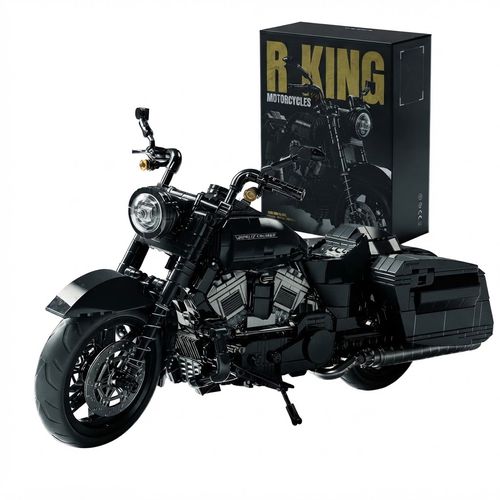
Push the finished cruiser forward and the V-twin pistons rise and fall with the wheels, visible between the frame rails. Work through 1,339 parts in about 5 hours and a 15-inch cruiser lands with high handlebars, a dual seat, and wide panniers. Peel a sticker onto the instrument cluster of a budget bike kit and it lifts at the corner within a season. Thumb the gauges here and they are printed into the part, with metallic paint along the exhaust pipes. Start it on a Saturday afternoon and finish the same day; the 4,099-part supercar wants three weekends and a wider shelf. Read all 65 verified buyer reviews in one sitting; at 4.3 stars the sample runs thinner than anything else here.
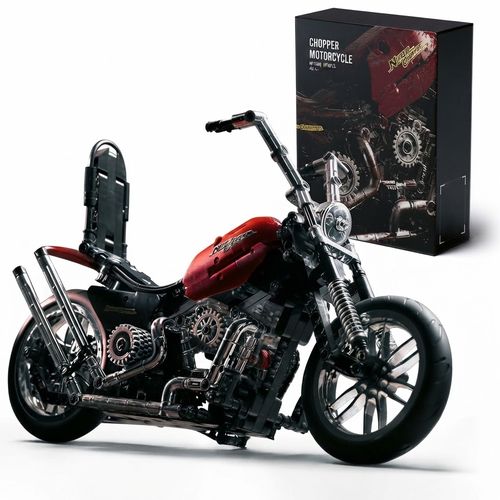
Give one evening to 572 parts and a 13-inch chopper stands at 0.75 kg, light enough for a narrow shelf. Roll the wheels and the V-type engine's pistons move with them, the same mechanism the flagship car runs at seven times the piece count. Nudge an entry-tier display bike along a shelf and its engine stays one moulded block between the rails. Turn this frame under a lamp and electroplated parts pick out chrome on every cylinder fin. Tip the single storage box onto a kitchen table and the whole sort fits in one evening. Snap two bricks together from that box before ordering a 4,099-part build; the clutch power tells you what the plastic is worth.
Build hours from 4 to 20, assembled weight, storage-box counts, and gearbox positions appear on every listing here. Category buying guides skip them.
| Measure | What it changes for you | Where the gap sits | Source |
|---|---|---|---|
| 4–20 hours | Clear one evening for the 572-piece Chopper Motorcycle and it finishes in about 4 hours. Spread the 4,099-piece ASIL Sports Car across weekend sessions instead: that one runs closer to 20 hours. | Open a category buying guide and one vague hours range covers every alternative-brick kit; check any set here and the hour count sits on its own listing. | Manufacturer spec, per-model build-time estimate |
| 0.75 kg to 6.49 kg | Lift the finished Chopper Motorcycle one-handed at 0.75 kg and it sits on a narrow shelf. Clear real desk space for the ASIL Sports Car instead, which lands at 6.49 kg assembled. | Run down a category buying checklist and assembled weight never appears, yet that number decides whether a bracket holds the finished model or sags within a season. | Manufacturer spec, item weight field |
| 1 to 5 storage boxes | Open the single box that ships with the 572-piece Chopper Motorcycle and the first sort takes minutes. The 2,899-piece Willis Off-Road Car scales that same sorting system up to 5 boxes. | Read a rival page on sorting and it stops at the words numbered bags; cut the tape on a carton here and you can count the boxes before the first bag opens. | Manufacturer spec, included components field |
| 7-speed gearbox | Flip the paddle on the ASIL Sports Car and the gearbox cycles all 7 speeds under your thumb. Turn the wiper key beside it and the split suspension drops from stiff track mode to soft cruise while the car sits on the shelf. | Read a rival guide and it credits a kit with functional gears, then stops; thumb the paddle here and you can count the shift positions yourself before the body panels close. | Manufacturer bullet points, ASIL Sports Car listing |
| Since 2019, Guangdong | Line up the 2023 Big Boy Locomotive beside the 2026 Abrams-X Tank and you span most of the run since Nifeliz Group started shipping out of Guangdong in 2019, from a 4-hour motorcycle to a 20-hour supercar. | Search a rival brand page for a founding year or a headquarters and you come away empty; both details sit on every listing here instead. | Brand research, company background |
| 4.4 stars, 3,612 reviews | Set the 65-review R-King Motorcycle beside the 1,292-review Big Boy Locomotive and both land within a tenth of the same 4.4-star average. Add up every listing and that average rests on 3,612 verified buyer reviews. | Click through a rival brand page and the star rating floats with no buyer count under it; here the count sits beside every rating, so you can weigh a thin sample against a deep one before ordering. | 3,612 verified buyer reviews |
| About 20 min per bag | Work the ASIL Sports Car's bags one at a time and each runs close to 20 minutes, per owner build reports. A 4,099-piece flagship becomes a string of short evenings instead of one lost weekend. | Most build-time answers hand you one total hour figure and leave you guessing where to stop; time a single numbered bag here and you know when to close the box for the night. | Owner build reports, per-bag pacing |
Pistons, a 7-speed gearbox, a 2WD/4WD selector, and openable engine bays separate a moving model from a glued shelf ornament.
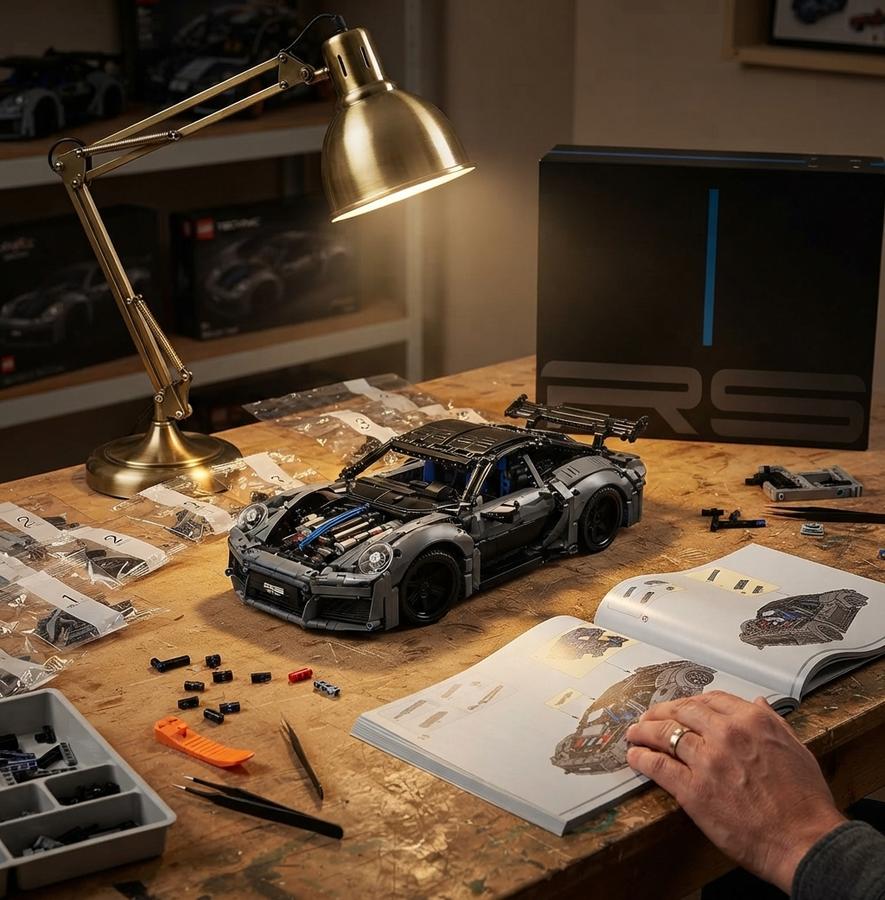
The Stinger RS Sports Car runs 2,362 pieces and 11.5 hours of building before its rear cover lifts for the first time. Push the finished car across a desk and the linked V6 strokes in time with the wheels. Turn the steering wheel and the front wheels answer; press down on the body and the suspension loads under your hand.
The ASIL Sports Car reaches 4,099 pieces and 6.49 kg assembled, the heaviest build in the range. Flip a paddle behind the steering wheel and the gearbox steps through 7 positions with a click you feel through the plastic. Turn the wiper key and the split suspension drops from track-stiff to cruise-soft. Twenty hours of building end in a machine you operate rather than one you dust.
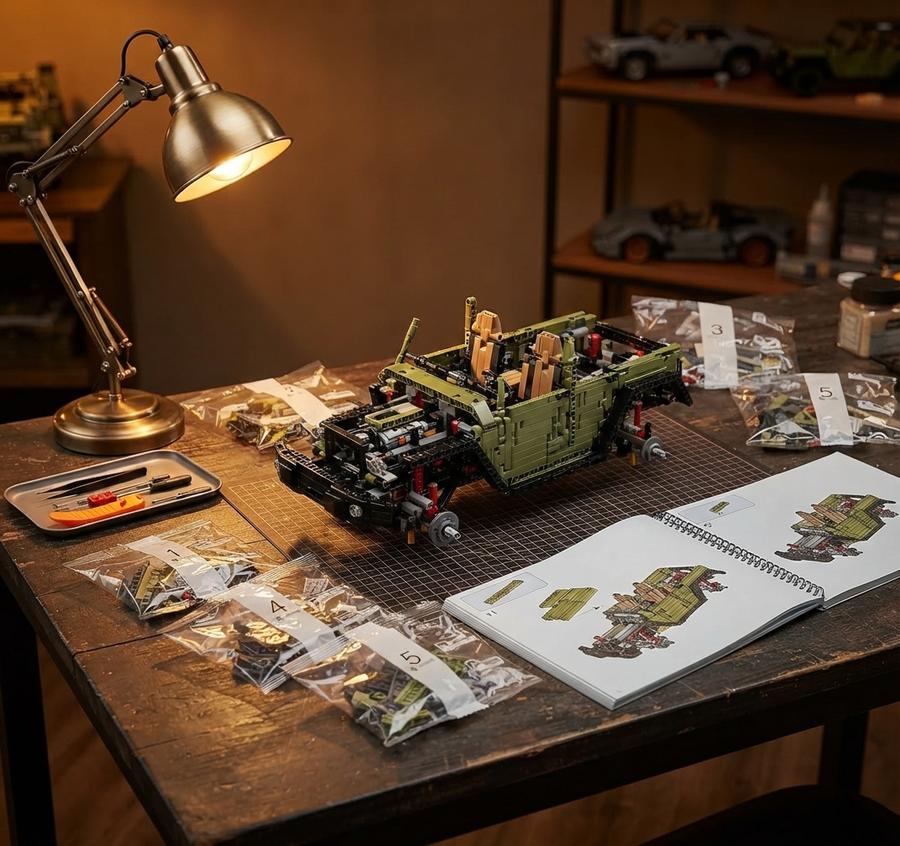
The Willis 4x4 Off-Road Car carries 2,899 pieces and the only Advanced skill rating on these listings. Shift the cabin lever between high and low speed, then from two-wheel to four-wheel drive, and the transfer case moves under the floor. Pull the roof and doors off and the truck switches to open trail form in under a minute.
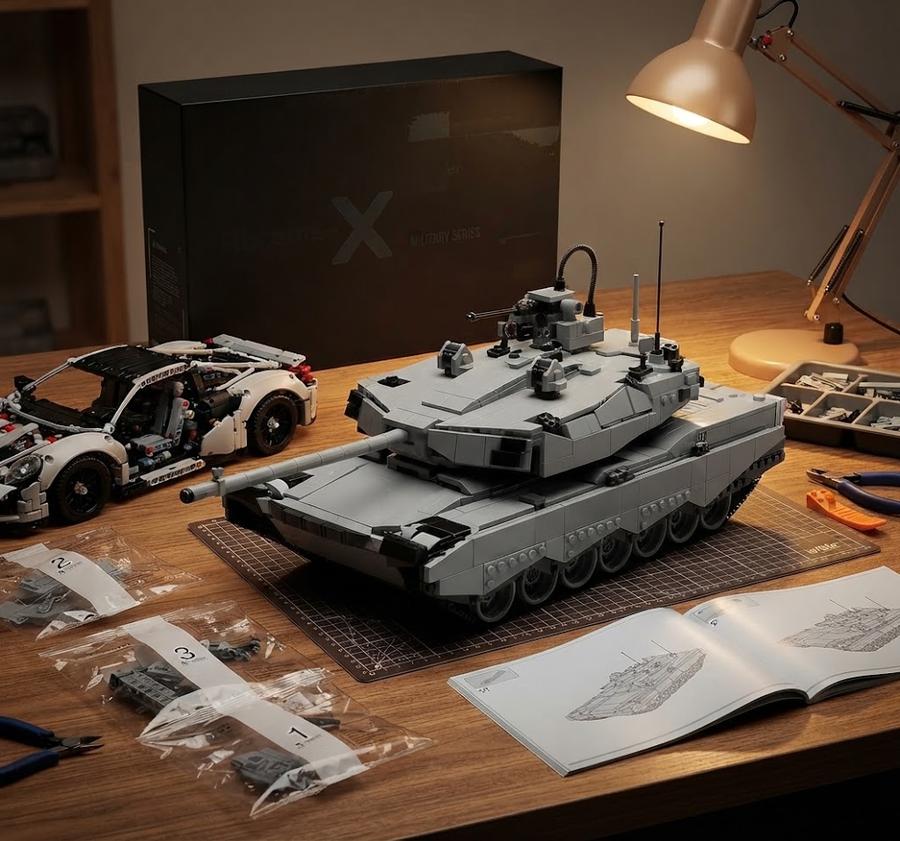
The Abrams-X Tank lifts its upper hull off entirely, and the driver's seat, loader area, and engine bay sit open after 8.2 hours of assembly. The Turbofan Engine skips covers altogether: a semi-exposed frame leaves the gear train visible while a hand crank drives it. Both stay openable long after the last brick lands, which a sealed display model cannot offer at any price tier.
Bricks that aren't LEGO deserve a hard look, so scroll back through the listing dates: the record starts in 2019, when Nifeliz Group began shipping Technic-style sets out of Guangdong, China. Line the ratings up seven years on and the spread shows plainly: 4.3 on the Abrams-X Tank, 4.6 on the Stinger RS Sports Car. Jump to the fears section below and the reasons behind that 0.3-star gap sit there by model.
You get mechanics that move, not a glued display shell. Roll a finished car forward on your desk and its pistons stroke off the wheel axle, because the drivetrain is geared rather than decorative. Every carton arrives sorted into numbered bags with storage boxes and a manual, so a 2,000-piece build breaks into evening sessions instead of one long weekend.
Thread an axle into these ABS bricks and it seats to standard Technic-style pin dimensions; on most vehicle builds the engine then turns off that same wheel axle. Trace that axle line through any vehicle build here and it ends at moving pistons, not a moulded block.
One verified review of the Big Boy Locomotive put the hesitation plainly: apprehensive about buying building blocks that aren't LEGO, then 1,818 pieces and about 4 hours later, convinced enough to say so in writing. Search every listing for a published warranty period and nothing comes back, not in any year since 2019. Cover comes from the retailer's return window instead, so count the bags against the parts list the evening the carton lands, not the weekend you start building.
How this brand started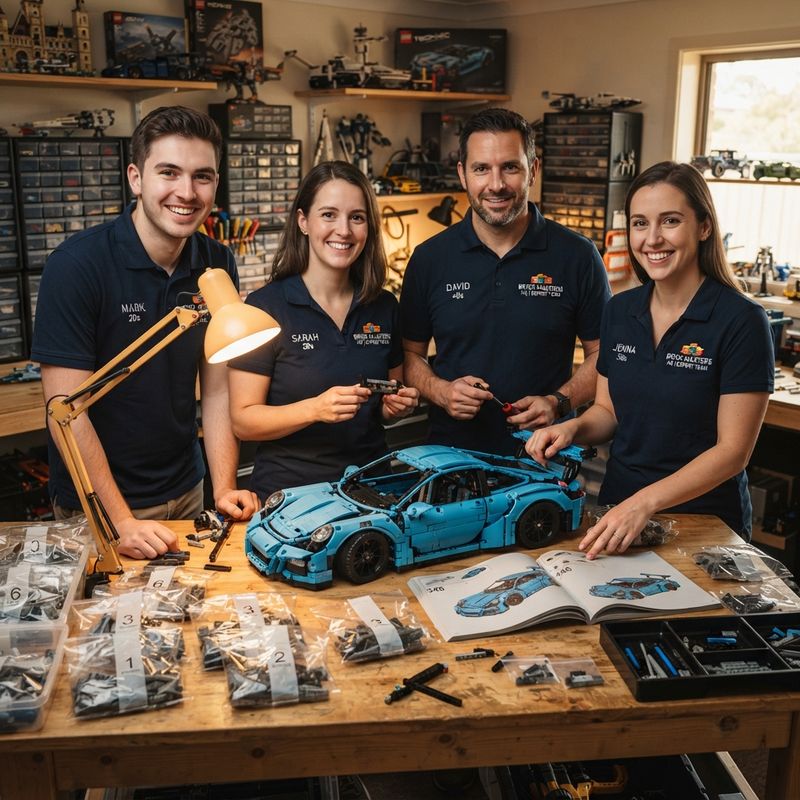
Every set ships parts in numbered bags with storage boxes, so a 4,099-piece flagship splits into 20-minute sessions.
Cut the seal, lift out the manual, and check every sealed bag against the parts list.
Tip bag one into the first storage box and leave the rest sealed until their step arrives.
Work one bag per sitting, roughly 20 minutes, and stop wherever the numbering stops.
Roll the wheels, open the engine bay, and confirm the pistons stroke before the model hits the shelf.
Verified buyer reviews from the listings, including the complaints, because a 4.4-star average is not a 5.0.
I was really apprehensive about purchasing this simply because it was building blocks that aren't Lego. It's my first non-Lego build, and I have built a lot of Lego sets. But after seeing some DIY Big Boy sets that just didn't look as good, I took the chance. The attention to small details is amazing. By far one of my favorite builds.
Hands down, one of the most challenging Technic builds I've encountered in my 71 years. Compared with comparable LEGO Technic models, this kit requires a lot of patience: looking for all-but-identical pieces with significant differences takes real attention. The result is worth the hours, but go in expecting to slow down.
The final build looks gorgeous. I keep seeing it from across the room and doubting that it's actually made of tiny plastic bricks, because it looks like a proper model railway piece. It took me about 5 hours to assemble, and it went together as cleanly as anything I've built.
Everything about this set was much more than expected. Big box, two instruction books that are very well printed with clear pictures, and two separate boxes inside holding the numbered bags. The packaging is better than anything I've seen at twice the piece count.
First, the best manual I've worked from. Great build and the parts fit well. My only disappointment was that I thought I was buying a powered unit rather than a hand crank; the description led me to believe there was a motor and there is not. The finished piece still earns its shelf.
Similar to a LEGO Technic build, only better engineered, if anything over-engineered, which means you have to follow the instructions carefully. The instruction book is highly detailed and beautifully printed. My husband received this as a gift, found no missing pieces, and worked through a lot of separated bags happily.
I tried this one because it costs less than the premium Technic shelf. My issue is that the parts are hard to connect sometimes; you have to be careful or you'll break your sub-assembly. I also had a couple of small pieces missing, and even a small piece will stall you. Still a good build for the hours it gives back.
I wanted to get back to building and got frustrated at the high prices on the premium shelf. I was looking for something past a thousand pieces, challenging and complex, and this gave me all of that. The quality held up and the directions were clear. It took a long stretch of evenings, which was the point.
Read what goes wrong before you commit 20 hours, then check each one against your carton the evening it lands.
Torn bags and short counts happen on alternative-brick kits, and one owner opened a V8 Engine box to find the elastic band missing outright. Check everything against the parts list before the first brick clicks. A short count found on day one goes back easily; the same count found at hour six does not.
Owners report the 3-speed transmission clicking a single time instead of stepping through gears, and it traces back to gear seating rather than a broken part. Rebuild that sub-assembly with the manual open beside you and leave a hair of clearance between moving parts. Turn the shifter through all three gears afterward and nothing binds.
Wheel friction on the 1,818-piece Big Boy Locomotive runs high enough that owners report it dragging on standard track instead of coasting. Check for a brick pressing against a wheel face, then loosen the axle seating before the boiler shell goes on. Fit a motor to it and the same friction fights back on every curve, which is why owners after a powered train start elsewhere.
4.4 stars across 1,292 verified buyer reviews
Sight down the ASIL Sports Car chassis at the wishbone mounts and one front wheel rides proud of the other by a stud's height. Correct it before the body panels close over the chassis, because parts lodge tight once 4,099 pieces surround them. Owners who caught it early backed out two steps instead of half a car.
Comb the fine print on any model here and no warranty period appears; pretending otherwise would be the easiest lie on this page. What covers you instead is the retailer's standard 30-day return window, which handles a dead-on-arrival carton, a ripped bag, or a short count. Inspect the box the day it lands, and that window is enough.
Retailer 30-day returns cover a short count — pick a set and compare piece counts.
Desk display, gift handoff, engine-bay show-and-tell, seasonal shelf rotation, and shared weekend builds across 572 to 4,099 pieces.
The 18-inch Stinger RS parks beside a monitor, and the first visitor who rolls it forward finds the engine turning. That usually ends the LEGO question.
Hand over the 2,899-piece Willis Off-Road Car when the recipient already finished a supercar kit; the Advanced rating and the 2WD/4WD lever give them somewhere new to go.
Someone always asks whether the engine underneath is just a moulded block. Hand over the finished Z240 Sports Car mid-conversation and the argument ends in about four seconds.
Spring comes and the 1,818-piece Big Boy Locomotive leaves its display track; the Turbofan Engine takes the same spot, crank still turning for whoever walks past.
Split the work between two builders and the 1,694-piece Z240 finishes in four sittings instead of eight, with nobody waiting on a sub-assembly.
Unboxing runs about 20 minutes; a 4,099-piece flagship takes 20 hours spread across whatever evenings you have.
Cut the carton seal, count the sealed bags against the parts list, and open bag one. Anything torn or short goes straight back through the retailer's 30-day return window, before a single brick clicks.
Four evenings at roughly 20 minutes a bag finish the 1,694-piece Z240 Sports Car, and the hood lifts on a completed engine before the weekend.
Pace the 4,099-piece ASIL Sports Car through weekend sessions until all 20 hours sit behind you and 6.49 kg of finished car needs a shelf of its own.
Two winters later the Abrams-X hull still lifts off on a slow evening, with the driver's seat and engine bay exactly where you built them.
Ready for Day 1? The 572-piece Chopper Motorcycle finishes in one sitting — compare it against the Z240 before you order.
The questions buyers send before their first non-LEGO carton, answered against the listings rather than around them.
Nifeliz is a brick-based model kit brand founded in 2019 in Guangdong, China, building Technic-style vehicles, engines, and trains for adult and teen hobbyists. Sets run 572 to 4,099 pieces in ABS plastic, and most vehicle builds carry pistons geared to the wheels.
Verified buyer reviews across the range total 3,612 at a 4.4-star average, running from 4.3 on the Abrams-X Tank to 4.6 on the Stinger RS Sports Car. The company has shipped from Guangdong since 2019. Legitimate does not mean flawless: owners report torn bags, occasional missing small parts, and a transmission that needs careful seating. Those complaints sit on this page rather than hidden.
Piece counts overlap with comparable premium Technic vehicle sets, and mechanics such as a 7-speed paddle gearbox and wheel-driven pistons match what the category expects at that scale. Where the premium brand still leads is manufacturing consistency, instruction clarity, and documented clutch power, none of which is independently tested for this brand. Owners who switch describe the trade in the same terms: mechanics and piece count for a lower tier, with the occasional torn bag or missing small part as the cost. Read the most recent reviews on the specific model before deciding, since consistency is the variable.
Nifeliz Group operates out of Guangdong, China, and has produced building sets since 2019. Design and manufacturing both sit there. The brand reaches buyers through online retail listings rather than its own shop network, so most people meet it on a product page.
Parts are moulded independently rather than sourced from the premium brand. ABS plastic here is cut to the standard Technic-style pin and axle dimensions the whole category shares, which is why builders mix pins from other alternative brands into these sets. Compatibility comes from geometry, not licensing.
Nothing on these product listings states a warranty period, and none appears on the packaging. That absence is worth naming rather than papering over: cover comes from the retailer's standard return window instead of a brand guarantee. Inspect the carton and count the bags on arrival, while the window is open. After it closes, replacement parts become a private-purchase problem.
Returns run through the retailer's standard window, typically 30 days from delivery, rather than through a brand-specific policy. A damaged carton, ripped bags, or a short count all qualify. Because no separate guarantee is published, the practical move is to open the box the day it arrives and check the bag count against the parts list before starting the build.
Certification marks such as CE, ASTM F963, or CPSIA do not appear in the published product data for this brand. Rival buying guides list them as a checkpoint, so their absence is a fair question to raise with the seller before ordering. The 16-plus age rating on most sets reflects small parts and build complexity, which is separate from any certification claim.
Piece counts run from 572 on the Chopper Motorcycle to 4,099 on the ASIL Sports Car, with mid-range builds between: 1,593 on the 1225 Locomotive, 1,818 on the Big Boy, 2,899 on the Willis Off-Road Car. Each listing states its exact count.
Build time runs about 4 hours for the 572-piece Chopper Motorcycle and roughly 20 hours for the 4,099-piece ASIL Sports Car. Mid-size kits land between: 6 hours for the 1225 Locomotive, 8.2 for the Abrams-X Tank, 11.5 for the Stinger RS, and 14 for the Willis Off-Road Car. Estimates assume steady work, so first-time builders should add time for sub-assemblies.
Piece counts and mechanics sit in comparable territory: a 7-speed paddle gearbox, working steering, and wheel-driven pistons all appear here, at a tier below the premium brand for similar scale. LEGO Technic still leads on tolerance consistency, instruction clarity, and decades of documented clutch power. Builders who switch most often cite the price-to-piece ratio, and their complaints land on instructions rather than on parts: a misread transmission step costs an hour to unpick. Neither company publishes independent test data, so weigh the comparison on scale and mechanics rather than on materials science.
Standard Technic-style pin and axle geometry is what these sets are built to, and builders report mixing pins across brands successfully, most often sourcing black pins from CaDA to replace the blue ones for a cleaner look. That substitution working at all indicates matching dimensions. What nobody publishes is a tolerance figure, so a pin that seats firmly today may sit looser after several rebuild cycles. No official compatibility claim exists from either company. Treat it as a builder-verified pattern, and test a spare pin before committing a whole sub-assembly.
Adult and teen hobbyists rather than young children: manufacturer minimum age reads 192 months, or 16 years, on most listings. Builds run 4 to 20 hours and demand patience with sub-assemblies. A first-timer should start at the 572-piece end.
Lower marketing spend, no licensed film or motorsport properties, and direct online distribution remove most of the premium. Tooling and ABS material costs stay comparable, which is how piece counts reach 4,099 at a lower tier. What gets traded away is brand-level quality-control consistency and published clutch-power data. Check today's price before assuming the gap holds in any given week.
Torn bags on arrival happen often enough that owners flag it regularly. Photograph the carton and the bags before touching anything, then start a return through the retailer while the window is open. A half-opened set can also mean a returned unit went back on the shelf, so check whether the carton seal was cut and resealed before assuming shipping damage.
Empty every numbered bag into a tray and re-check before concluding anything, since small parts hide in packaging folds and cling to the bag seam. One owner reported a V8 Engine set arriving without its elastic band. If the count is genuinely short, the retailer return window is the reliable route, because brand-level part replacement is not a published service. Generic parts from other alternative-brick brands sometimes fill the gap, though colour matching rarely works. Photograph the bag layout before you sort, so a claim has evidence behind it.
Sets sell through online retail listings rather than a brand-run storefront, which is why star ratings and buyer reviews sit on the listing page itself. Pricing shifts week to week, so check today's price on the specific model before deciding between tiers. Availability varies by model, though the entry motorcycle and the flagship car tend to stay in stock most consistently.
Star ratings quoted here draw from verified buyer reviews on the retail listings, totalling 3,612 across the range. Depth varies sharply: the Big Boy Locomotive carries 1,292 while the R-King Motorcycle has 65 so far. Treat a 4.3 built on 65 reviews as a thinner signal than a 4.4 built on 1,292, and read the most recent ones before ordering.
Metallic finishes on these parts are applied at the factory rather than by the builder, so the assembly risk is friction against other bricks inside a bag. Handle plated engine and exhaust pieces separately when sorting, and avoid dragging them across a bare table. No manufacturer claim about scratch resistance appears in the product data, so treat the finish as paint rather than armour.
Assembled weight spans 0.75 kg on the Chopper Motorcycle to 6.49 kg on the ASIL Sports Car. The Z240 Sports Car sits at 2.17 kg, the Abrams-X Tank at 3.02 kg, the Willis Off-Road Car at 4.63 kg. Check the shelf bracket rating first.
Longest axis on the Big Boy Locomotive reaches about 31 inches, the longest here, though its profile stays narrow at roughly 3 inches. By footprint the ASIL Sports Car claims the most desk area. Measure the shelf before ordering either one.
Paddles behind the steering wheel move the gearbox through 7 positions, and the change is mechanical rather than cosmetic: gears engage inside the transmission housing. A separate wiper key raises and lowers the split suspension between a stiff setting and a soft one. Neither function needs batteries, and both stay usable on the finished model, which is the payoff for a 20-hour build.
A cabin lever selects high or low speed range, a second shifts between two-wheel and four-wheel drive, and forward, neutral, and reverse sit on the drivetrain as well. The transfer case under the floor moves when you shift, so the mode change is visible rather than implied. This is the only kit here carrying an Advanced skill rating across its 2,899 pieces.
ABS engineering-grade plastic, listed as Acrylonitrile Butadiene Styrene on nearly every product page. The Big Boy Locomotive listing reads simply Plastic, which looks like an inconsistent entry rather than a different material. ABS is the same family the premium Technic brand uses.
Manufacturer minimum age reads 192 months, or 16 years, on most of these listings. That number reflects build complexity and small parts rather than any content restriction. A younger builder with large-set experience can manage the 572-piece Chopper Motorcycle with an adult nearby.
Storage boxes scale with piece count: one with the 572-piece Chopper Motorcycle, three with the 1,694-piece Z240 Sports Car, four with most mid-size builds, and five with the Willis Off-Road Car and the ASIL Sports Car. The flagship also ships two instruction books.
Most vehicle builds carry pistons geared to the wheels: the Stinger RS with a linked V6, the Willis Off-Road Car with an inline-four, the Chopper and R-King motorcycles with V-type twins, and the AM24 Formula 1 with a 6-cylinder. The V8 Engine and Turbofan Engine sets run their mechanics off a hand crank instead. Train and tank models focus on rod and interior detail.
Printing and stickers both appear, depending on the model. The Z240 Sports Car and the 1225 Locomotive use printed dashboard and cab gauges, and the R-King Motorcycle prints its instrument cluster. The AM24 Formula 1 ships authentic stickers for its livery, so budget a slow final hour for decal placement. Metallic-painted engine parts arrive finished and need nothing applied.
Sets around the 2,000-piece mark land between 7.5 and 11.5 hours: the 2,216-piece Turbofan Engine at 7.5, the 2,136-piece Abrams-X Tank at 8.2, the 2,351-piece AM24 Formula 1 at 8.5, and the 2,362-piece Stinger RS at 11.5. Spread across evenings at roughly 20 minutes per bag, that works out to a week or ten days of casual building.
Each bag runs close to 20 minutes on the ASIL Sports Car, per owner build reports, with roughly 100 pieces and about 30 steps inside. Stopping at a bag boundary leaves the model stable rather than half-assembled.
Stopping at the end of a numbered bag is the clean break point, and the storage boxes exist for exactly that. Leave unopened bags sealed, keep loose parts from the current bag in one box, and mark the manual page before walking away. A paused build survives weeks this way. Mixing two opened bags into one tray is what turns a pause into a search.
Every set here ships as manual mechanics, with no motor, battery box, or receiver in the carton. Builders do fit third-party Technic-compatible motors, though results vary sharply by model. The Big Boy Locomotive is a poor candidate specifically: wheel friction runs high, and owners who tried report the drivetrain fighting the motor rather than turning with it. A car or off-road chassis with a free-rolling drivetrain is the easier starting point. Roll the finished model by hand first, because a chassis that drags under a push will drag under a motor.
The ASIL Sports Car occupies roughly 23 by 11 inches and weighs 6.49 kg finished, which rules out most floating shelves rated for light decor. A bookshelf with a solid deck handles it. The Big Boy Locomotive needs length rather than depth at about 31 inches, so a mantel or long shelf suits it better than a cube unit.
The 1,694-piece Z240 Sports Car splits well: three storage boxes, about 6.8 hours total, and enough parallel sub-assemblies that two builders are not waiting on each other. Divide the bags rather than the steps. Larger kits work too, though the ASIL Sports Car's two instruction books mean one person tends to own the manual and set the pace.
Age 16 is a manufacturer recommendation tied to build complexity and small parts, not a legal restriction. A 12-year-old with large-set experience will manage the 572-piece Chopper Motorcycle in an evening with an adult nearby. Gearbox-heavy builds are the harder call: the ASIL Sports Car's transmission punishes a misread step, and correcting it later means dismantling body panels.
Start with the 572-piece Chopper Motorcycle at about 4 hours if the goal is judging part quality cheaply. For a first substantial build, the 1,694-piece Z240 Sports Car at about 6.8 hours gives an openable hood, doors, and working steering without a transmission to misassemble. Save the 4,099-piece flagship until one mid-size kit is behind you.
Both brands occupy the alternative-brick tier and both use ABS. Mould King leans harder into motorized and remote-control builds, while every set here runs manual mechanics only: no motor, battery box, or receiver in any carton. For a builder who wants a powered chassis out of the box, that difference decides it. For someone who wants a hand-operated gearbox and an engine bay that opens years later, the manual approach is the point rather than a gap. Neither brand publishes independent tolerance data, so review depth is the practical tiebreaker.
CaDA holds a reputation as the tighter-tolerance option among alternative-brick brands, and builders here sometimes source CaDA pins as replacements when swapping blue pins for black ones. That substitution working at all indicates dimensional compatibility between the two. On scale and mechanical ambition the two overlap closely: multi-thousand-piece vehicles, working gearboxes, panels that open. On published test data, neither company releases independent figures, so the comparison rests on owner reports. Check the review count behind each rating before treating a half-star gap as meaningful.
Independent clutch-power test data does not exist for this brand, so stating parity as fact would be dishonest. Owners report parts holding well enough for large chassis builds without spontaneous separation, and pins from other alternative brands seat correctly in these sets. What nobody has documented is how the grip behaves after repeated disassembly and rebuild cycles over several years. For a set built once and shelved, the question matters less than instruction clarity. For one that gets pulled apart and rebuilt, budget for pins loosening.
Comparable-scale premium Technic vehicle sets sit a tier above these on the same listing pages, while piece counts stay inside the same 572 to 4,099 band. Lower marketing spend, no licensed film or motorsport properties, and direct online distribution account for most of the gap. Prices move week to week on both sides, so compare current listings rather than trusting any fixed ratio. Check today's price on the specific model, because the gap on a 4,099-piece flagship rarely matches the gap on an entry motorcycle.
Boxes stay useful once assembly finishes. Builders keep spare parts, the extra pieces that ship with most sets, and small sub-assemblies inside them. The five boxes from the Willis Off-Road Car or the ASIL Sports Car are large enough to hold parts from a second build entirely. Nothing about them is display-specific, so most end up in a drawer or on a workbench.
Dust with a soft brush or a bulb blower rather than a cloth, since a cloth catches on protruding pins and pulls small parts loose. For heavier grime, a barely damp cloth works on flat panels. Keep water away from metallic-painted engine parts and printed gauges, where moisture lifts the finish. Compressed air at close range can dislodge sub-assemblies, so hold the nozzle well back and work in short bursts.
A single click instead of a full shift on the Stinger RS traces back to gear seating rather than a broken part. Open the manual to the transmission sub-assembly and confirm each gear sits exactly as shown, orientation included, since a mirrored gear looks right and behaves wrong. Moving parts need a hair of clearance; a gear pressed flush against the frame will bind. Back the section out and rebuild it rather than forcing the shifter, which can shear a tooth. That rebuild costs about half an hour against living with one usable gear.
Uneven ride height at the front usually traces to the wishbone mounting steps, where a mirrored part can go in the wrong way round and still click home. Correct it before the body panels close over the chassis, because parts lodge tightly once 4,099 pieces surround them. Back out to the affected sub-assembly rather than forcing the arm: forcing it can crack the mounting point, and a cracked mount is not a part the brand replaces. On a finished car, lift the rear cover first to reach the shock mounts.
Wheel friction on this 1,818-piece locomotive runs high relative to its weight, and owners report it dragging on standard track rather than coasting. Check first for a brick pressing against a wheel face, then for an axle seated too tightly in its housing; loosening the axle mounting by a fraction usually frees it. The articulated frame adds drag through a curve, so test the roll on a straight section before blaming the wheels. That same friction is why motorizing this particular model frustrates builders who try.
Finished models hold their shape on a shelf as long as nothing lifts them by an unsupported panel. Stress shows up first at long unsupported spans, such as a locomotive boiler or a car door left hanging open. Lift large builds from the chassis rather than the bodywork, and support the heaviest build under its floor pan when it moves. Handling is what loosens joints, not shelf time, so a display-only model stays stable for years without attention.
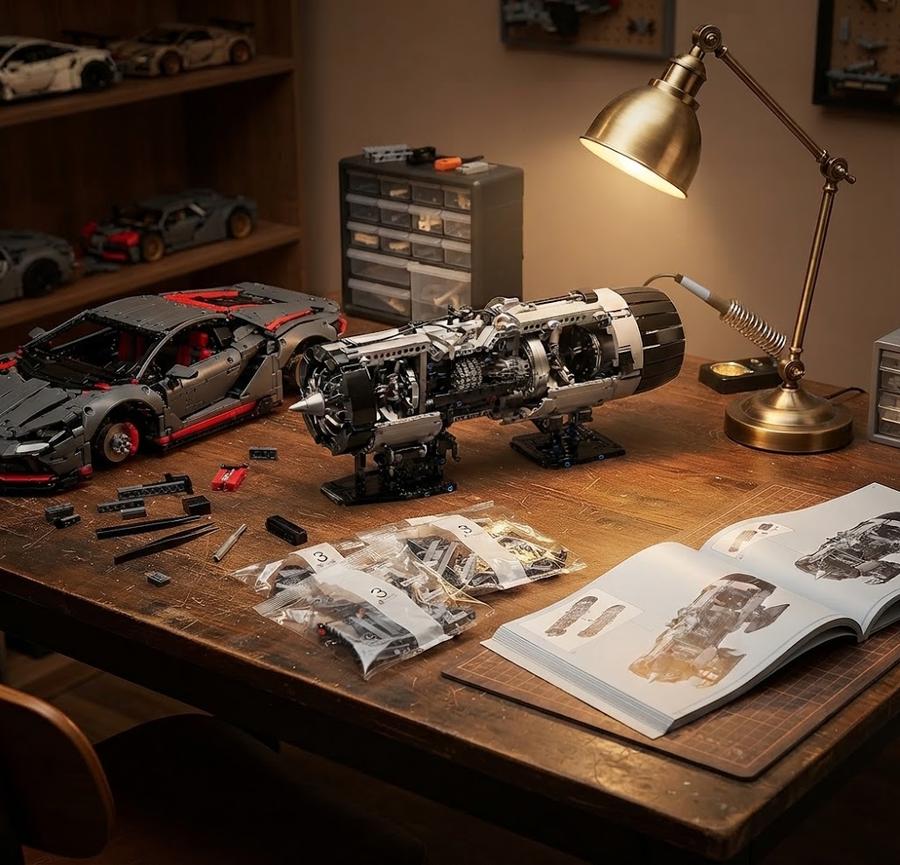
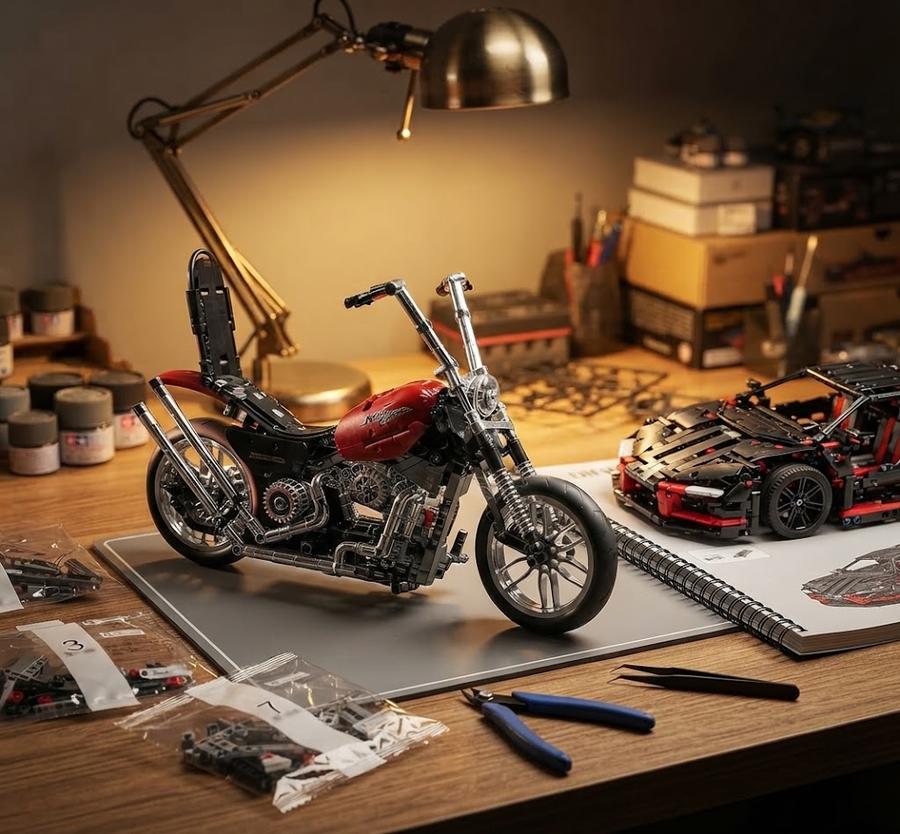
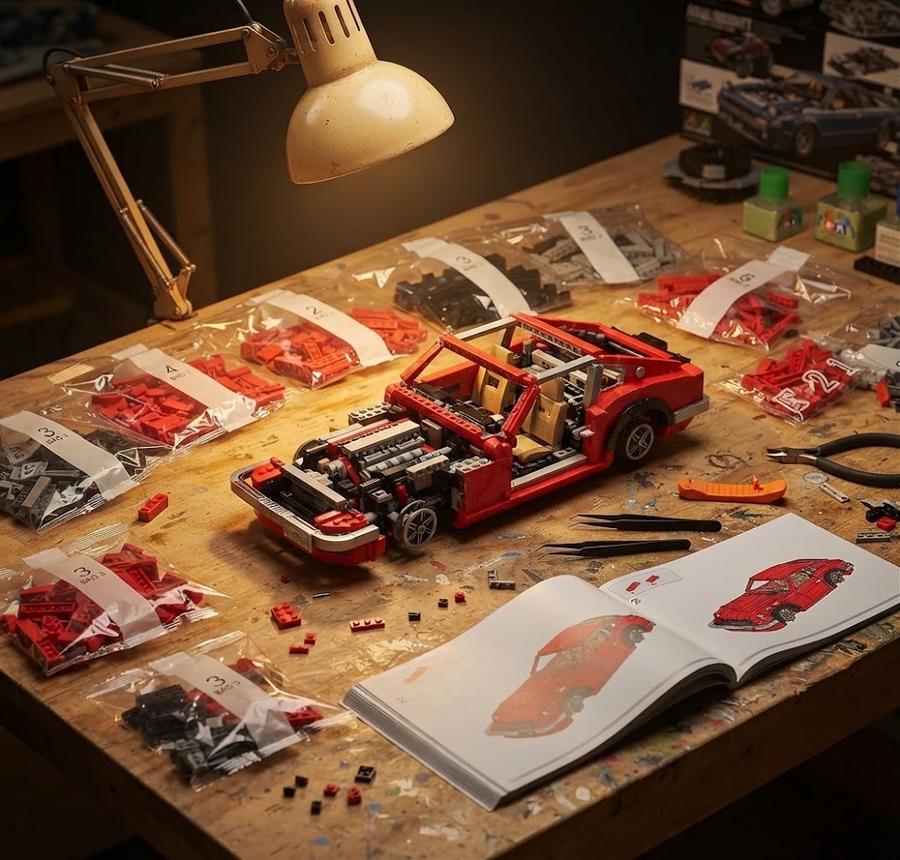
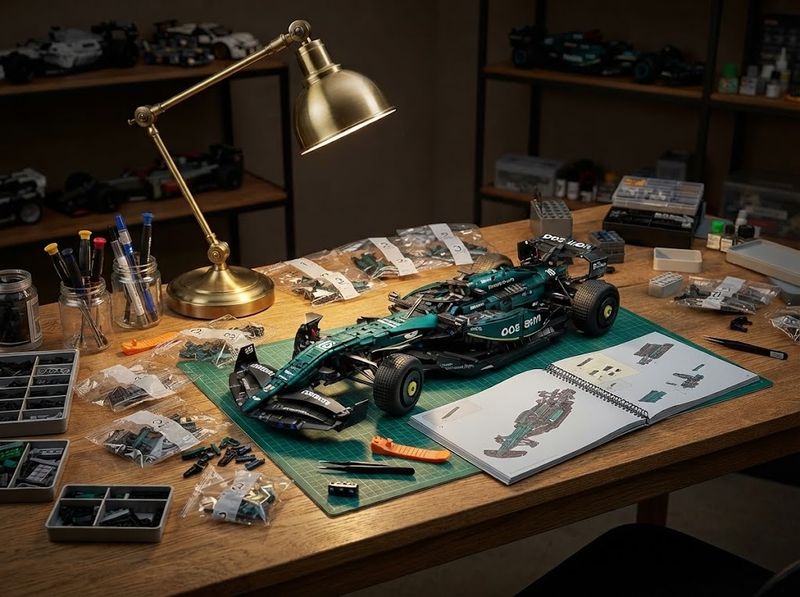
Assembled models photographed where they end up: workbenches, bookshelves, and the corner of a desk beside a monitor.